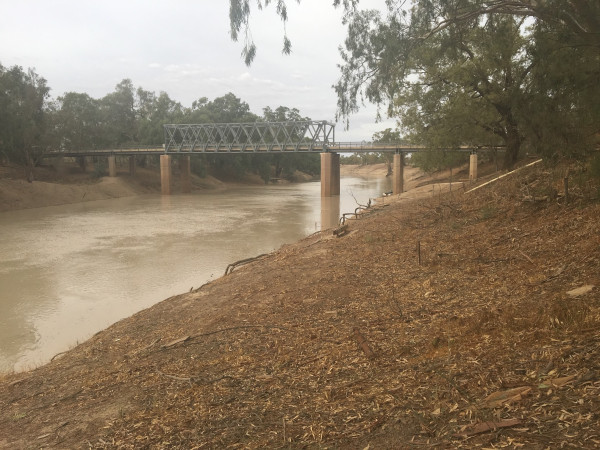
ALMOST 10,000 megalitres of water a day is passing through the Darling River at Tilpa as it heads towards Menindee.
According to the Murray-Darling Basin Authority (MDBA), the first protected flows are expected to reach Menindee Lakes in mid-March.
MDBA chief executive Phillip Glyde said the flows were being closely tracked by satellite as they headed into the heart of the basin to ensure compliance throughout temporary water restriction zones.
Mr Glyde said that two months ago just about all New South Wales was drought-declared and the focus was rightly on ensuring communities had enough critical water until rains came.
“Thanks to significant rain in parts of northern NSW and Queensland since mid-January, some rivers are now flowing again, some at flood level,” he said.
“In line with the basin plan, these first flows have been protected and are expected to reach Menindee Lakes this month.”
Mr Glyde said the flows were testament to the basin plan, that irrigators in Queensland knew the rules, and therefore knew when they could start taking water in line with the State Government’s water resource plans.
“Water resource plans are a fundamental part of the basin plan,” he said.
“They set clear, transparent rules on how much water can be taken from every catchment in the system and are published for all to see.”
Mr Glyde said credit was also due to the NSW Government for imposing wide-ranging embargoes on water extraction to protect the first flows, as they had agreed to do.
However, he said downstream water users were confused and criticised the partial lifting of the embargoes.
“These decisions appeared ad hoc and were not transparent,” Mr Glyde said.
“We will work with both state governments after this event to identify where processes and transparency can be further improved.
“Quite rightly, communities need to trust that governments are actively managing this finite resource as they agreed they would.
“There’s a variety of water users with an interest in this transparency — tourists, families and communities, First Nations people, irrigators, industries and of course the needs of the environment itself, which underpins all other needs.”
Mr Glyde said Australians expect the MDBA to keep an unbiased and whole-of-basin perspective.
“This unwavering commitment is more important than ever because water is scarce, and it is becoming scarcer.”
Water resource plans go to stakeholders
NSW Water Minister Melinda Pavey says she will take the state’s water resource plans for eight surface water areas back to stakeholder advisory panels for comment before submitting them to the Commonwealth for accreditation.
Mrs Pavey said she would not be rushed by deadlines that did not recognise the pressures put on rural communities by what remained a significant drought in the NSW area of the Murray-Darling Basin.
“The community has made a huge effort to comment on the draft plans during the public exhibition phase last year,” she said.
“Now I want to go back to the stakeholder advisory panels with an analysis of key community concerns and make sure these have been adequately considered in the latest draft.
“It is vital that we close the loop with stakeholders before the water resource plans are submitted to the Commonwealth for assessment and accreditation.”
Mrs Pavey said the stakeholder advisory panels would be convened for the regulated river valleys and the Barwon-Darling system during March.
Consultation on the Murray-lower Darling region will be held at Deniliquin on March 18 and the Barwon- Darling region at Bourke on March 24.