2021 is going to be landmark year for Red Cliffs. Over Melbourne Cup weekend the town will celebrate its centenary birthday and the committee overseeing the celebrations are urging us all to “get Reddy” for one heck of a party. Committee members Helen Petschel and her husband, Bob Walton, chatted with Danielle Wilcock about the town’s history, giving us an insight to what we can expect from the four day festivities.
IN 1920, surveys of the Red Cliffs area began. Alfred Kenyon was the superintendent of the development. Without his foresight and acute engineering and agriculture knowledge, Red Cliffs might never have been established nor even selected for settlement.
Kenyon was placed in total charge of Red Cliffs manifestation, his first task was to contour the land. Bob Walton, centenary committee member and Red Cliffs Historical Society education officer, explains the uniqueness of this.
“Red Cliffs was divided into blocks based on gravity, they all flowed and followed the contours of the land,” he says.
“After they were mapped out the first to be surveyed and set up was on the Eastern side of the railway line.”
Something many might not know about this little country Victorian town, is that Red Cliffs was recognised as the largest solder settlement in Australia after WWI, with over 700 blocks allocated. Interestingly, two women were allocated blocks of their own, something that was largely unheard of. One of these women was Veir Scott, a nurse who served at Gallipolli.
Helen Petschel, a centenary committee member and Red Cliffs Citizen of the Year, awarded at this year’s Australia Day, offers some more unique facts about Red Cliffs’ origins and identity.
“The settlers came from many nations and were not all Australian returning service men and women,” Helen explains.
“Red Cliffs was planned as an irrigation settlement on gravity fed vineyards.
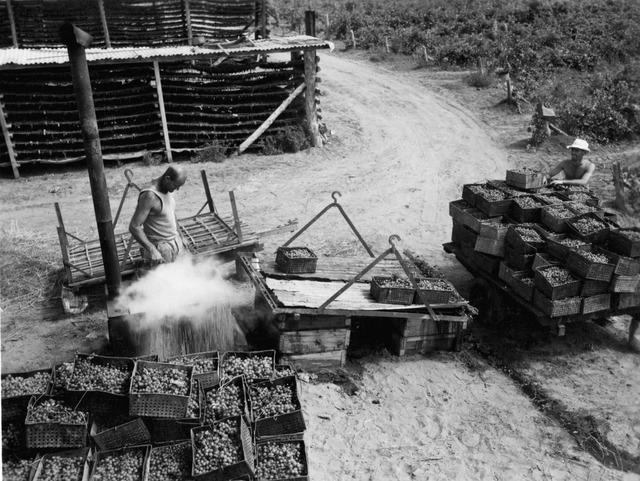
“Plans were initially based around the growing of dried fruits, especially sultanas.
“They also made provisions for natural reserves to be set aside in order to preserve the differing types of vegetation from the local area.”
Streets in Red Cliffs are named after plants and rivers, as opposed to war related titles, as is the case in other soldier settlements.
“They all returned with some form of anxiety or stress from the war, now we’d call it PTSD,” Helen says.
“They didn’t want the streets named after war time events as it would have reminded them about their trauma.”
Red Cliffs’ origins are both unique and groundbreaking. Not only was the planning of the settlement meticulously thorough, but the original settlers were introduced to the area and recognised immediately as locals.
“They all arrived at the same time in the same boat. They were allocated blocks and educated on how to work the land,” Bob says.
“What’s really interesting is after they arrived here and straight away they were regarded as a local.
“They had this tremendous camaraderie and spirit of being a true local.”
There’s been some debate surrounding the town’s infancy and when its founding year should be observed. Both Helen and Bob offer an explanation as to why 1921 was agreed upon by the pioneers despite them living, working and establishing their blocks prior to this.
“The pioneers chose October as their anniversary, because they felt there wasn’t really a community until water ran in the channels,” Helen says.
“In October 1921, that is when the pumps started and the first water ran in the channels.’
Bob says the community decided that water was their lifeblood and “that was their start”.
The decision to commemorate the town’s establishment, wasn’t made until 1946, 25 years later.
“The founding settlers decided the on the town’s 25th birthday,” Helen says. “They then went onto their 50th and 75th.
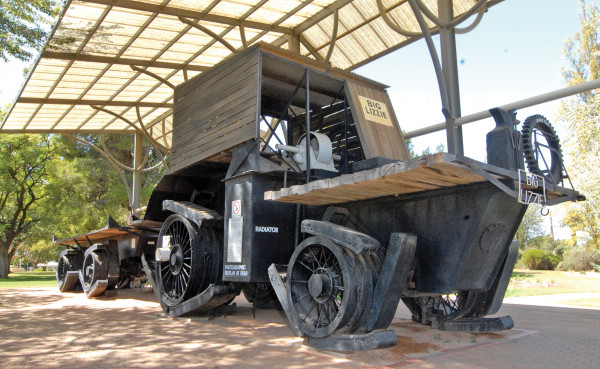
Big Lizzie, which was brought back to mark the 50th anniversary in 1971, is iconic to Red Cliffs’ identity and features prominently in the heart of the town.
In early 1915 Frank Bottrill commenced construction of Big Lizzie to replace camel trains which carried wool and other heavy loads over the sandy outback terrain. After construction of her finalised in 1916, she embarked on a tumultuous journey from Richmond, expecting to arrive in Broken Hill in 1917. Through stroke of fate and a flood that made it near impossible to cross the Murray River, Big Lizzie landed in Mildura, unable to reach her final destination.
She was finally put to work in 1921, when she commenced clearing scrub for the proposed 6,000 ha irrigation area that we now know to be Red Cliffs.
To bring her back to the region in 1971, was a mammoth task but it was one that Red Cliffs leaders were keen to accomplish.
“She was down at Glendening station in the Western District, she’d had gone down there to do some work,” Bob explains.
“She certainly wasn’t working and driveable, they had an incredible low loader. We have a film of being unloaded, which is actually the only film of it moving.”
This film alongside other home movies and recordings will be on display over the course of the four day event next year.
Plans for the anniversary have been in works since February, 2017.
“We got together just to brainstorm some ideas, the Red Cliffs Historical Society ran this first meeting,” Helen says.
“We had a really good turnout and got some great ideas, that we’ve been able to follow through with.”
Due to the enormity and significance of the event, a dedicated committee was formed last year.
The event is expected to include billy cart racing, TQ and cycling events, as well as themed dances and a special centenary country market.
“We will be holding a variety performance, the local choirs, orchestra and district bands are all keen to get involved as well,” Helen says.
“A TRACS display of machinery, a big street parade and possibly a pool party will also feature as part of the celebrations.
“The Red Cliffs baths have been a big part of the lives of local residents, past present and future, so we’re keen to include it in the celebrations.”
Something the pair are quite proud of and no doubt the entire committee are keen to promote, is the establishment of a walking trail that will scope the heart of the town. They aim to incorporate all Red Cliffs schools as part of the trail, each designing their own “post” which they hope will showcase their schools origins and tell the story of the town.
“Where looking at having story posts celebrating certain things about Red Cliffs history,” Bob says.
“Each story post will be designed by the children and tell each of their stories.”
By the time the centenary celebrations come around, the committee hopes to have these story posts erected and the walking trail already established. They will compliment the peace walk, located off Indi Ave, that was officially opened as part of the centenary anniversary of ANZAC Day.
Another significant part of Red Cliffs’ colourful history that will be showcased during in the celebrations will be Queen Elizabeth’s visit in 1954.
“A famous figure of Red Cliffs was Nat Barclay, who the town’s square is named after. The Queen Elizabeth actually visited his block,” Bob reflects.
“She also visited Quandong Park where 30,000 people came from the Mallee and surrounds to see her visit.”
Wonderful photographs and leftover relics from that day will be on show during the event, while the Diggerland Church will also be opened to festival goers.
“Diggerland was the town’s main hall, there was an inside picture theatre and dance hall that was built especially for the diggers,” Helen says.
Some of the celebrations will be held inside Diggerland.
Dates have been locked in for the centenary celebrations but a definitive program is yet to be formulated.
The event will run from Friday, October 29 to November 2. More details can be found on the committee’s Facebook page redcliffscentenary2021.