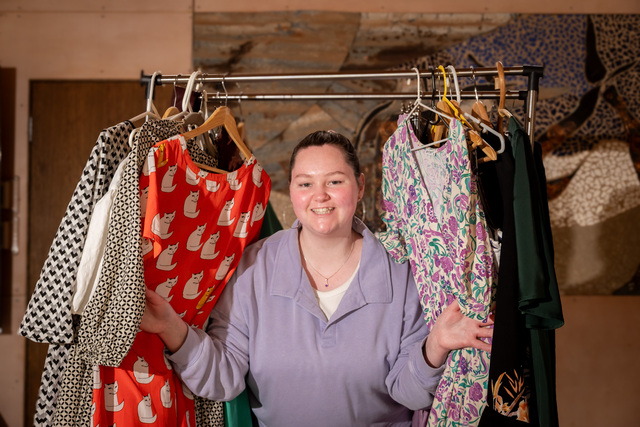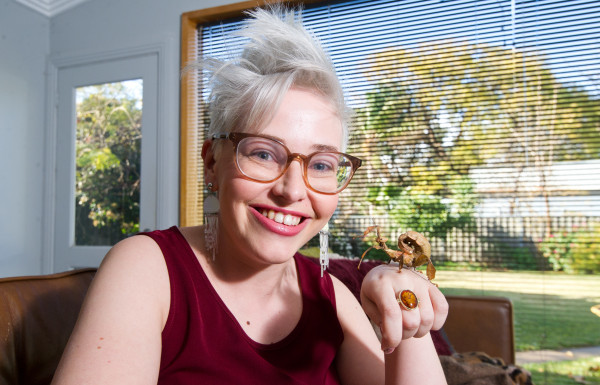
Local primary school teacher Erin Hammerton opens her home for an afternoon chat with Jessica Cornish to share her love of her pet Australian stick and leaf insects. Pictures: Carmel Zaccone
EVERY day, local primary school teacher Erin Hammerton carefully opens the large mesh enclosure door that sits in the corner of her living room and hunts through frass (also known as droppings) and remnants of shriveled gum leaves as she delicately collects tiny speckled eggs.
The intricately patterned eggs belong to Erin’s more unusual pets – stick insects; which have become “a pretty big hobby” of hers over the past 12 months.
Her relationship with the native critters began when she decided her Mildura-based class was in need of a pet project.
“I was trying to think of animals the kids hadn’t seen before because they come from lots of different cultures, plus I was just looking for interesting things that wouldn’t need much care. And this is what I chose after a bit of research,” Erin says.
Starting her collection required some planning.
“People on Facebook have been a great help. There’s a swapping and buying group I’m a part of called Australian Stick and Leaf Insects, that’s been good for getting tips and ideas,” she says.
While finding her initial leaf like friends took a bit of time, they were eventually delivered in a good old Tupperware container lined with moist kitchen toweling and snacks from northern Queensland.
However, Erin hopes that the days of new friends arriving in the post have finished, as her “spinney girls” have been laying at least two to four eggs every day.
“The females can procreate on their own without the male which is pretty amazing to me. However, if a female lays on her own it will turn out to be a clone,” Erin explains.
Meaning the nymphs (babies) will have the exact DNA replica of their mothers and the genetic gene pool won’t widen.
The eggs can take years to hatch so Erin has been trying to speed up the process from tricks she’s been gathering online.
“I’ve put cold water on them which is meant to stimulate where they live in the wild. So they’ve had a bath a few times,” Erin says.
Another really important aspect about trying to breed her little friends is that Erin needs to be vigilant and collect the eggs regularly because of the way nature has programmed the female stick creatures to thrive in the wild.
“The mother will flick the eggs with her tail onto the bottom of the cage because in nature an ant would take it away down to its ant nest thinking it’s a seed,” she says. “Eventually they hatch and come back into the treetops. It’s pretty crazy. When they’re born they look like ants, so they can get away with it.”
It’s things like this that draws Erin to these unique critters.
“There’s a few reasons I like them. I like that they are always changing, they shed their skin regularly throughout their life; really, I like things that can withstand harsh environments. They just need gum leaves and water,” she says.
Despite her passion for her pets, not everyone receives them so well and reactions often vary.
“The kids were initially quite cautious of their new school class pets because they look a bit like scorpions and rear up on their hind legs when they’re scared; but in reality they are only strong enough to bite through leaves,” she says.
“Some of my family don’t want to touch them because they’re bugs and find them creepy whereas my Dad loves animals and is always wanting to do things for them.”
Erin will often bring her pets out for a bit of interaction, as long as they’re not laying any eggs and she’s comfortable with leaving their enclosure open for minutes at a time.
“I’ve only had a couple of escapes before, but not so much now. They just sit on the cage mostly and they don’t go far at all,” she says.
And just when you think that you’ve seen all there is to see in her home, Erin’s proudly announces, “I do have something else as well. I have giant burrowing cockroaches too.”
Sitting quietly in another room on the corner of her desk is a large open glass tank with a layer of dirt and local foliage playing home to her other friends. Erin peers into the tank hoping to glimpse one of her newest adoptees.
“They’re not like normal cockroaches; they live in the dirt and they can weigh up to 30 grams,” she says.
“They get quite big but they’re pretty special in the fact that they give birth live, so they don’t lay eggs. So the mother will actually tend to them for some time which is pretty special and these guys malt too. But they’re not like regular cockroaches they’re a bit sweeter I think.”
So the verdicts in, not the regular house cockroach that has most people running for the bug spray but a “special” version adopted following a school incursion of a wildlife show earlier in the year. Who knows what will end up next in Erin’s collection of wonderful creatures.