COMMENT: BERNARD HUMPHREYS
Getting the disclaimer out of the way early, I’ve got to say I’ve always been a huge fan of Melbourne.
In fact, before heading there this week on an assignment that lasted not much more than 24 hours, I joked to a friend that a day spent in the Victorian capital for work is better than a week’s holiday almost anywhere else (and I wasn’t totally joking).
Having said that, though, this was my first visit to the city since before a pandemic that was supposedly going to strangle it to death. Although I certainly didn’t really expect the dystopia promised by the lockdown moaners and some right-wing political mouthpieces, I had been following actual facts about the loss of workers and students from the CBD, the closures of businesses and of course the lack of tourists and their dollars, so I did half expect to find a place that was somehow less than it had been, a jewel that had lost its shine.
Yet as I walked the streets of that CBD, the only gloom came from the grey and drizzly late-May weather. If there was any doom in that chilly air, I didn’t feel it.
Last month, it was reported that Melbourne had become Australia’s biggest city, albeit by statistical technicality, with 19,000 more people than Sydney, and population experts pointed out that while much was made of people moving out of the cities during the height of lockdowns, more people had actually moved in to the southern capital.
Now, I was in Melbourne for just two half days and a night and so my observations are hardly a scientific analysis, but I feel pretty confident in saying that the heart of the city is very much alive, which goes against the predictions of many.
Not all cities have the sort of pulse Melbourne does. For instance, I lived in Adelaide for many years and I love that place, too, but it doesn’t have it. On the other hand, I went to New York City just before the pandemic and of course it not only has it, but pretty much invented it.
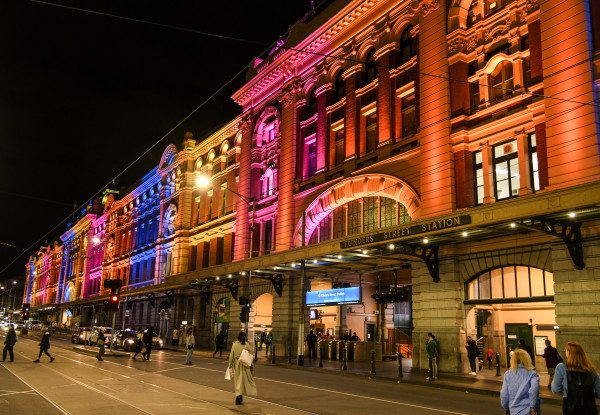
Melbourne is not New York, of course, but as I brushed shoulders with hundreds of people while working my way through a Tuesday shopping crowd on Swanston Street this week, I was reminded of that feeling of industry and urgency that’s often referred to as hustle and bustle in great cities. The noise, the lights, the traffic, the laneways packed with coffee meetings, the tourists taking selfies at Flinders Street Station, the students flowing in and out of the campuses and libraries, the big museum exhibitions, the hit theatre shows, the packed pubs and restaurants and the extraordinary coffee-shop queues, the busy shops and retail arcades, the footpath detours around the sites of new skyscrapers going up and a new subway going down.
Sure, these are all things one should expect to find in a big city, but I mention again that this was supposed to be the city that died in the pandemic, and it’s not just surviving; it’s clearly thriving.
There are good reasons why, in this remote corner of the state, we often feel neglected by government and corporate investors who prefer to spend their money in the nation’s biggest (or near biggest) city. But that’s not Melbourne’s fault.
And those of us who haven’t spent any time there in the past three years could easily be to led by the doomsayers to believe it’s become some a sort of ghost town. But that’s not what Melbourne is.
It was already one of the world’s great cities before the pandemic and now, having shrugged that off, it’s arguably the nation’s biggest and best city.
And it’s our capital city and it’s okay to be proud of it.
I recommend spending at least a day or two there when you can. It will probably be better than spending a week almost anywhere else.