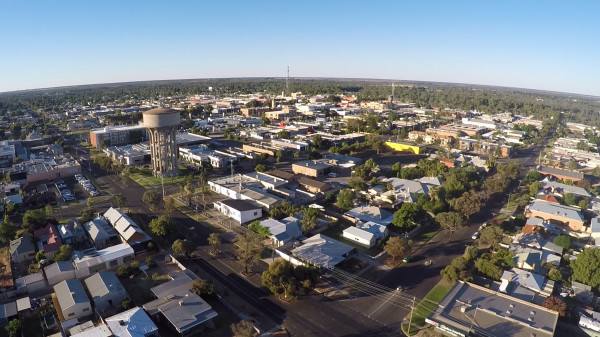
FOR decades, regional communities like Mildura faced a conundrum.
Governments wanted to redirect population growth from the large cities to the regions, while towns wanted industries to expand and new families to settle — in order to grow or, in some cases, avoid decline and population loss.
Yet, despite these largely aligned intentions, and as the spoils of a 28-year run without a recession were distributed, regional towns and centres struggled to keep up with the capital cities.
Could the COVID-19 economic shock trigger a reversal of the trend?
The Demographics Group co-founder and director of research Simon Kuestenmacher said there were a number of reasons why Mildura could be a big winner in a post-coronavirus world.
Jobs were the first reason — or more specifically, the type of jobs being created.
The prominent demographer said in a typical year, Melbourne and Sydney — which make up about 20 per cent of the Australian population — would capture about 30 per cent of all population growth.
Mildura last year, by comparison, accounted for .21 per cent of Australia’s population but only captured .17 per cent of the growth.
“The problem has been that people move to where the jobs are, and just the kind of jobs that we added to Australia over the last two or really four decades were mostly those knowledge jobs,” Mr Kuestenmacher said.
“We still might think of Australia as a middle-class, working-class country dominated by manufacturing and tradie middle-class workers that you know can afford to raise a family on a single income.
“That is Australia of the 1970s, that’s not the case anymore.
“We’re now way more an economy that relies on knowledge work jobs and those knowledge work jobs, they just like to cluster in the inner city, because an accountant really benefits from being close to their clients, the new tech IT business needs to be next to a bank, needs to be next to other IT business.”
When it comes to offering knowledge jobs at scale, Mildura doesn’t have the right conditions to keep pace.
After the coronavirus, however, Mr Kuestenmacher can see a change in the type of new jobs being created, including a fresh attitude towards local manufacturing.
He said COVID-19, which drew attention to the country having only one manufacturer of face masks, would prompt governments to back such a change.
“It’s (been) difficult because we didn’t have any tools to incentivise jobs to go to the regions, because the jobs that we wanted to create for a long time were only those knowledge jobs … but now with manufacturing, there’s plenty of manufacturing that doesn’t need a really complex ecosystem to support it.”
Then there was the cost benefits of manufacturing in a regional area, where warehouse rents are lower and with cheaper real estate workers could enjoy “a significantly better life in a regional town”.
Post-virus, governments could also be keen to kick-start economic growth through infrastructure spending.
Mr Kuestenmacher speculated that regional connectivity would be a likely focus.
Another change observed in recent weeks was an attitude change from people living in capital cities about living regionally.
The spread of the virus has meant regional towns were being perceived as “safer” at the same time as high-density settlement loses some appeal.
“In Australia, all 25 million people are on their sixth week of lockdown,” Mr Kuestenmacher said.
“And if you live through this experience in a small house, in an apartment, then you really understand how nice it would be to have a little backyard, to have a bit more space to move into, maybe another bedroom for your yoga exercises … these kind of stories.
“That is a big drawcard for regional Australia, and what a change in perception that is.”
The trend towards working from home could also change how people think about the home.
Do they need more room? A study perhaps?
Mr Kuestenmacher said Mildura might not see as many benefits from such a shift compared with satellite cities such as Bendigo, because workers were likely to still be required in the office on occasion.
But some roles may be able to be performed further away.
Could innovations like telehealth prompt the reverse to happen — more professionals providing their services to regional towns from other places?
Mr Kuestenmacher said he believed people would still prefer to see their doctor in person for the time being.
The risk for regional communities, he said, was that they didn’t grasp the opportunity in front of them.
He urged Mildura leaders to be bold in their efforts to capitalise.
“Right now it’s the biggest window of opportunity — and way bigger than I ever imagined it being even two months ago — to actually entice people to come to regional Australia,” he said.
“And you do want to benefit from this, you do want to be very bold at the moment in your lobbying efforts to the State Government, in order to ensure that you get your fair share of road upgrades, of whatever it takes (to grow the manufacturing sector).”
Bold messaging also needed to be put to potential workers.
“You need to actually paint a vivid picture of … ‘you live in a house that is 50 per cent larger than it is in Melbourne, your commute is half as long and now your kids can actually take the bike to school’, whatever it is.”
Four reasons why we’ll grow
Demographer Simon Kuestenmacher’s four reasons why regional Australia stands to benefit in a post-coronavirus world:
1. Jobs growth will shift from knowledge work, often clustered around capital cities, towards manufacturing, which can be done in regional areas.
2. In the economic recovery, governments will look to spend on infrastructure. Regional connectivity could be a focus.
3. Regional living, including having larger homes and more backyard space, will be viewed more favourably.
4. The normalisation of working from home will allow some professionals to live in a different location to their workplace.